Following the publication of ‘The Prodigal Project: journey into the emerging church’ in 2000 (Riddell, Pierson, Kirkpatrick, London: SPCK) I have received a steady flow of requests for resources to stimulate new ways of doing worship and church. Surprisingly, there has been little published to meet this desire. Wild Goose has continued to produce very useful resources, and Johnny Baker and Doug Gay have recently added their excellent material (Alternative Worship. London: SPCK, 2003) to Sue Wallace’s two books on rituals for alternative worship (see Resources, section 7). But that’s been about all. Having spent almost two years of spare time getting this resource to publication stage, I now know why!
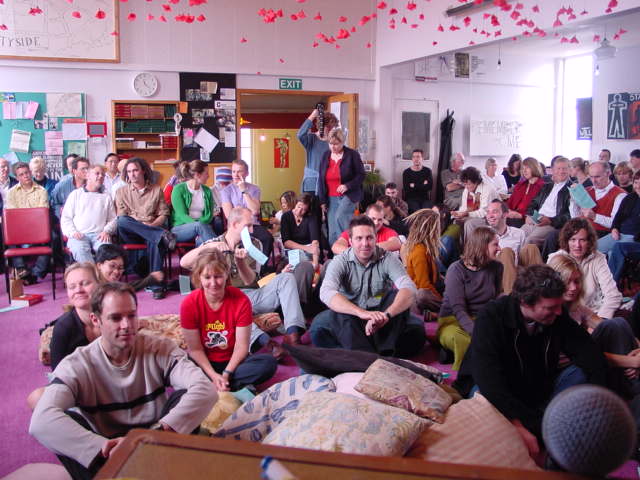
Fractals is unashamedly a collection that comes almost entirely from a single source — the community that is Cityside Baptist Church on the inner-city fringe of Auckland, New Zealand. Over the last decade this stunningly gorgeous and creative group of people, which during this period grew from 20 to 160, has consistently inspired and encouraged me with the stuff they turn up to worship with. This collection collates some of that material. It is their book.
I have chosen not to go into much philsophising or theologising. Of the postmodern shift there is more than enough written. There is much less done about building communities of Christian faith in the emerging cultures this shift creates. Cityside is our attempt at that. We have not arrived. We continue on our journey. I do not present what we do as a model for anyone else to copy. That would be the height of arrogance and a denial of what I understand about emerging cultures. Cityside is the response of a community doing ministry and mission with the resources it has and in the cultural contexts it finds itself. Our worship is part of that response. Your setting, and therefore your response, will be different.
We do not present what we do as a model to be followed by anyone else.
We make our resources available in the hope that some part of them may spark ideas in you that fit the community of people you are worshipping with. To that end everything we offer here is re-useable. You are welcome to download anything you want onto your computer, to modify it how you wish and to make it your own. The CDROM should allow you to do that and also to print out anything you want to. Every file has a ‘raw data’ number. That will take you to the file to print or download it. Mac users will need to browse the ‘Source’ folder on the CDROM to access the articles in Word Format) It is also possible to select, copy, cut and paste text directly off the screen as you read it.
We would be grateful if you would credit any chunks to their source. And we’d be really delighted to hear about how you have used stuff and what you are doing to strengthen churches around the world engaging with their cultures (fractals@cityside.org.nz). There are lots of gaps in what we are providing you. A lot happens ‘on the fly’ and isn’t recorded at the time. If you particularly want information on something you can’t follow, email us. This work is published under a Creative Commons License that you can view online at <u><a href=“http://creativecommons.org/licenses/by-nc-sa/2.0/”>this address</a></u>
It was my intention to have a hard copy of the material to go with the CDROM. Scanning text on a monitor is slow and not as accessible as a book in your hand. Unfortunately the quantity of text we ended up with made that uneconomical in our self-publishing context.
Please don’t copy the CDROM. Encourage others to purchase it from the same email address above.
Everything we do is inspired by something someone else has done or said. Sometimes sources are remediated several times and the original is lost. We apologise for anything we may have credited wrongly, or not credited at all. Please let us know if you find these mistakes or any other form of error, so we can make corrections to future editions. American readers will notice the lack of ‘z’s and the overabundance of’s’s and ‘u’s. A reminder that globalisation is not yet complete!
Why fractals? Fractals are repeated geometric patterns. They occur in nature. They are associated with chaos, randomness, chance, self-similarity, repetition, creativity and beauty. They are used by artists, mathematicians, poets, choreographers, and scientists. One of the properties of fractals is that they represent a finite area bounded by an infinite line. They are made up of ‘little copies of themselves buried deep within the original.’ They have infinite detail. While we operate in three dimensions measured in whole numbers eg two or three, fractals operate between dimensions (although they cannot have a dimension higher than the dimensions they appear in!) e.g. 2.3 or 1.7. They represent a new branch of mathematics only a few decades old. They describe shapes not able to be described by traditional Euclidean Geometry. Fractals provide the perfect mix between randomness and order. You can find copious amounts of information about them by entering the term in a web search or visiting <u><a href=“http://sprottphysics.wisc.edu/fractals”>this address</a></u> (which is where I got most of my information from.)
‘Fractals for Worship’ is an attempt to provide some creative material that might be modified and repeated in expanding and deepening patterns of worship and church life: patterns not adequately described by previous traditional categories. My hope is that we will discover and enter new dimensions of worship and church life that will communicate the Jesus story to people untouched by traditional means and forms. My fear is that you might think changing worship is all the church needs to do in order to connect with those outside its walls. Much more important than what we do in worship are the values and principles that undergird those activities. Look for them as you use this resource.
My thanks to Brenda Stone for her wonderfully patient typing, editing and researching of much of this resource; to those who made the work possible with their financial support; to alt. worshippers everywhere; and to Citysiders current, previous, and future for their inspiration. Unless it is attributed otherwise, I probably wrote it or curated it.
Thanks also to Cam Hooper and Luke Munn for design.
Greetings to Citysiders everywhere and from all times. You can take the punter out of Cityside, but you can’t take Cityside out of the punter. Once a Citysider, always a Citysider. Thanks for keeping me sane and saved.
Future volumes are yours to write.
Yours surfing the edges for the Kingdom of God,
Mark Pierson,
Auckland,
New Zealand.
Pentecost 2004.