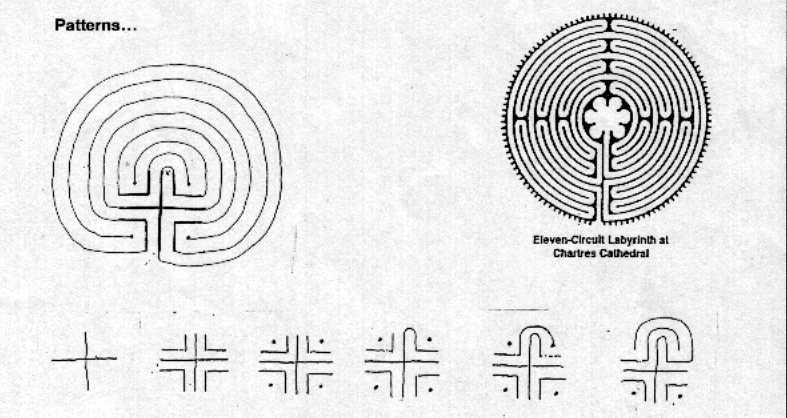
A labyrinth is a pattern marked on the ground or floor that is walked as an aid to reflection and meditation. While not specifically Christian in origin or in contemporary use, it has ancient roots as a tool for developing Christian spirituality. Here is not the place to describe the details of labyrinth history (you can get excellent information from the resources listed below), but basically by the Middle Ages it was dangerous for pilgrims to travel to Jerusalem, and seven European cathedrals were built and designated as destinations for pilgrims. Entering a cathedral’s labyrinth marked the end of a difficult journey and the promise of entry into the ‘celestial city’. In Chartres, pilgrims who were going to be baptised the next day walked the labyrinth on their knees.
The current worldwide revival of interest in the labyrinth as a tool for spiritual formation was sparked by the very recent re-discovery of the Chartres Cathedral Labyrinth in France.
A labyrinth has only one path and is not a maze. You cannot get lost in a labyrinth. The journey generally consists of three parts — the journey in, being at the centre, and the journey out.
We have several pairs of people who are responsible for setting out the labyrinth and creating the environment in which people will walk it. We use the Cretan Labyrinth pattern, as it is smaller than the Chartres one and so will fit into our limited space, and because it is simple to lay out new each time. We prefer to create the path fresh each month rather than using a pre-painted canvas that would be necessary with the more complex Chartres pattern. This allows the people laying it out to invest their own creativity in it and we may have the labyrinth laid out in wool (the most common), leaves, stones, flowers, or some other materials. Our floor is carpeted so wool ‘sticks’ to it. In other settings we have used chalk, flour, or sand.
Around the pattern on the floor are often: candles (for minimal lighting); communion elements (available for self-service); and perhaps an icon or painting or station of some sort (for guided reflection). Music plays throughout the evening.
We advertise the Labyrinth Prayer Walk to be open from 7pm to 8.30 pm, and encourage people to arrive before 8pm. Basic verbal instruction is given at about 7.10pm each time.
We have printed handouts available at the door. They cover such information as…
When you are ready to walk the Labyrinth…
- Take off your shoes (you can leave socks on).
- Pause at the entrance.
- Clear your mind; become aware of your breathing.
- Enter at the pace your body wants to go.
- Look down: watch the path and your feet.
- You may pass others, or let them step around you.
- Stay on the path, i.e. the space between the lines. If you cross a line you change direction!
- Those going in will meet those coming out.
- Don’t overcrowd the labyrinth: 6 or 7 is probably enough in it at one time.
- Walk slowly. Place one foot in front of the other. Step in time with your breathing.
- When you reach the centre, stay there for a while. Notice the sensations in your body, your awareness…
3 stages of the journey
1.Walking In (Purgation) – letting go, releasing the details of your life in prayer, quieting your mind, giving the details of your life to God. ‘Cast all your anxieties on him because he cares for you.’ 1Peter 5:7.
2.The Centre (Illumination) – receiving in prayer and meditation. Stay as long as you like. Receive what God has for you – cf. Mary sitting at Jesus’ feet. Luke10: 38-42.
3.Walking Out (Union) – joining with God, moving out into the world, taking the light of Christ with you.
There are a lot of possible variations on environment set-up for your labyrinth. Sometimes we theme a night and give people printed scriptures to reflect on as they walk, or have particular music or images available. It is possible to create bulges in the pattern when you make it fresh each time, to accommodate stations within the labyrinth. At the centre we generally have a cross or a candle.
Finding appropriate music is one of the most difficult tasks. It needs to be fairly even, i.e. no sudden crescendos or changes of pace. Generally slower pieces work best, and instrumental rather than with lyrics. Surprisingly, some drum and bass and jazz can work well too. The track/s can be repeated through the event, but if they’re too short this isn’t so effective.
If you do a web search for information, be aware that not all of the sites you come across will be Christian. Some will be quite the opposite. A labyrinth pattern is neutral. The content comes from those who walk it. It becomes an aid to Christian meditation if that is the intent you have when you walk it.
Patterns… The very simple Cretan Labyrinth is drawn as follows… You can make the path as wide or narrow as you have room for. Keep in mind that the cross you make to start the pattern is not the final centre of the labyrinth, so if your space is tight adjust the setout to compensate. The final labyrinth will occupy a square about 14 times the width of the path. Again, adjust the width to suit your space. I also like to bulge the centre space to create more room than the pattern below suggests. This means that the outer paths simply bulge around it too.
(See Resources section 7, for books and weblinks on the labyrinth)